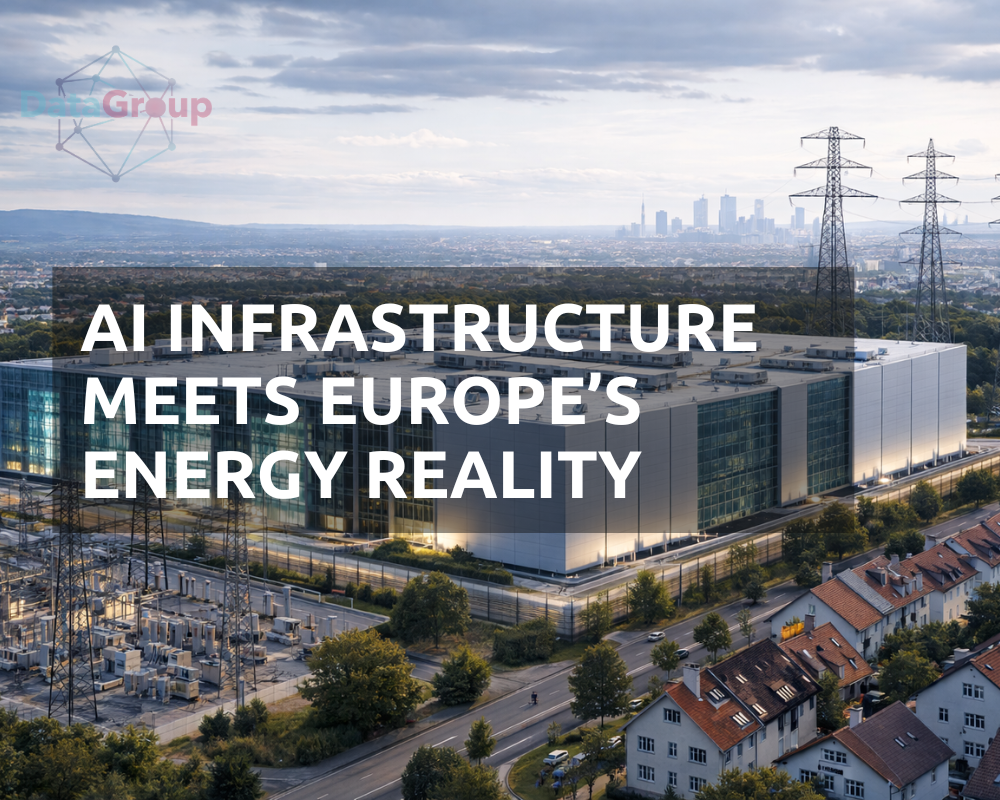
Europe’s data center market is entering a pivotal phase. Investment remains strong — but growth is no longer constrained by capital. It is constrained by power.
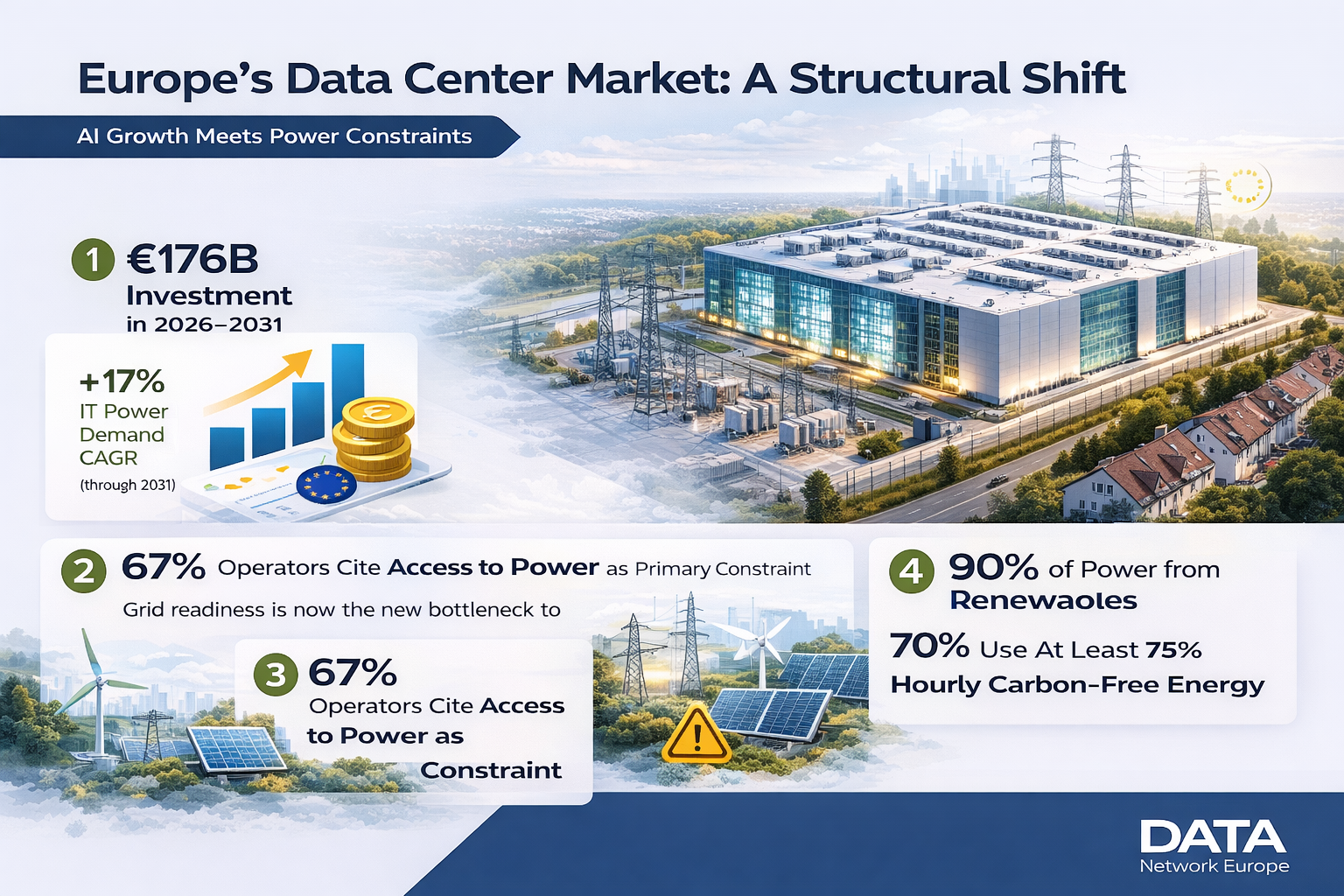
According to the latest industry outlook from the European Data Centre Association (EUDCA), cumulative investment in European data center infrastructure is projected to reach €176 billion between 2026 and 2031. Yet grid readiness, not funding, is becoming the defining bottleneck.
For enterprise IT leaders, this marks a structural transition in how infrastructure must be planned.
From FLAP-D to Distributed Growth
Historically, European data center expansion concentrated around the FLAP-D markets — Frankfurt, London, Amsterdam, Paris, and Dublin.
Today, operators are increasingly decentralizing into secondary and emerging regions in search of:
- Available grid capacity
- Faster permitting processes
- Land suitable for AI-scale campuses
- Renewable energy sourcing
This redistribution reflects a deeper shift: infrastructure planning is now aligned with energy strategy, not just connectivity and capital access.
AI Workloads Are Redefining Facility Design
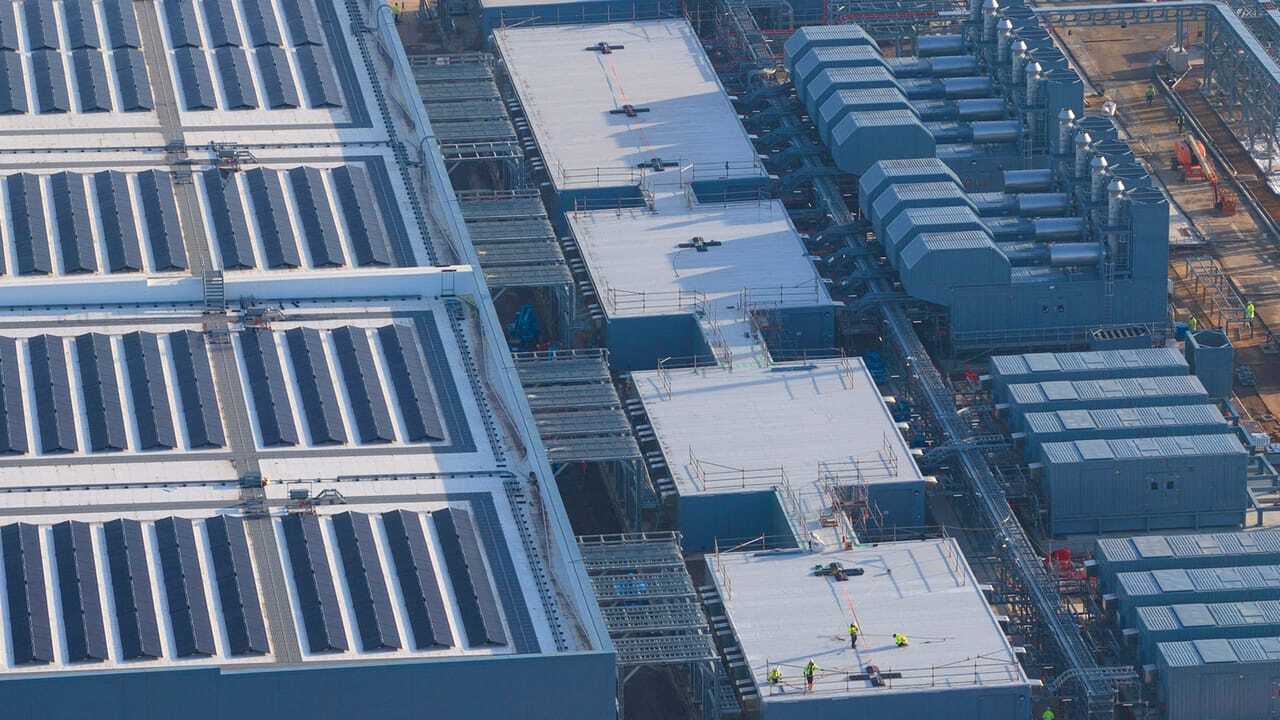
AI clusters are accelerating infrastructure density. Traditional rack densities of 8–12 kW are giving way to 60–80 kW per rack for AI workloads.
This evolution drives:
- Rapid adoption of liquid and hybrid cooling
- Increased IT power demand (17% CAGR projected through 2031)
- Strain on transmission and distribution networks
- Greater volatility management in renewable-heavy grids
AI training workloads gravitate toward regions with abundant renewable energy, while inference capacity remains concentrated near population centers for latency-sensitive applications.
This dual model is reshaping the geographic logic of European data centers.
Power Access Is Now the Primary Constraint
67% of operators now cite access to power as their greatest operational challenge.
Interconnection timelines in some markets exceed data center construction timelines. Grid congestion, regulatory complexity, and local opposition add further friction.

At the same time, the industry continues progressing on sustainability:
- 90% of electricity consumed by European data centers is sourced from renewables
- 70% of operators meet at least 75% renewable or hourly carbon-free energy standards
- Over half have achieved their 2030 WUE targets
The challenge is not ambition — it is coordination.
The Growth Model Has Changed
Europe’s data center expansion is no longer shaped primarily by:
- Capital deployment
- Real estate availability
It is shaped by:
- Grid capacity planning
- Energy infrastructure development
- Policy alignment
- Regional energy resilience
Energy systems have become the structural framework within which digital infrastructure must operate.
What This Means for Enterprises
For organizations planning AI infrastructure, the implication is clear:
Infrastructure strategy must integrate energy strategy.
This includes:
- Regional grid analysis before workload placement
- Energy-aware architecture decisions
- Adaptive cooling models
- Diversified regional deployment
- Long-term regulatory risk assessment
AI readiness is no longer just about GPUs or storage performance. It is about energy resilience.
DATA Network Europe Perspective
As a multi-vendor systems integrator and MSP operating across Europe, DATA Network Europe works with enterprises navigating these structural shifts.
We help organizations:
- Design AI-ready infrastructure aligned with regional grid realities
- Deploy hybrid architectures across power-diverse regions
- Integrate storage, compute and networking optimized for high-density workloads
- Plan capacity growth within energy and regulatory constraints
Europe’s digital future depends on coordination between infrastructure operators, policymakers and energy stakeholders.
The next wave of data center growth will favor those who understand both compute and power.
👉 Explore how DATA Network Europe approaches AI-ready infrastructure strategy: